|
Logbook from 26 July 2004 to 31 May 2005
26-Jul-2004
- Arrived in Madison. Start of the visit to install the complete tomographic system
30-Jul to 6 Aug 2004
- Test of the new Joerger TR1612 digitizers. Problems with the driver of the module. Installed 5 TR1612 in the CAMAC rack #1, in the same slot of the previous digitizers (Joerger TR612/3, to be shipped back to RFX), slot 13...17. There should be only 4 digitizers dedicated to SXR tomography but since there are a few of them which are not used I put it an extra one on, in order to get all the 66 channels.
- Installed all four cameras electronics. Only the SXR3 encoder system is not working.
7 Aug 2004
- Installed a new BNC panel on the CAMAC rack #1, for all cables coming from SXR1 and SXR2 probes, and the patch cables to the digitizers. This panel (by J.Sarff) will be replaced soon with a new one.
- Installed all patch cables for SXR probes. The following is the layout of the diode and inputs of the digitizers:
TR1612_1
slot13 |
diode |
|
TR1612_2
slot14 |
diode |
|
TR1612_3
slot15 |
diode |
|
TR1612_4
slot16 |
diode |
|
TR1612_5
slot17 |
diode |
|
input 1
|
SXR1, 1
|
input 1
|
SXR2, 8
|
input 1
|
SXR3, 7
|
input 1
|
SXR4, 3
|
input 1
|
SXR4, 19
|
|
2
|
3
|
2
|
9
|
2
|
8
|
2
|
4
|
2
|
20
|
|
3
|
5
|
3
|
10
|
3
|
9
|
3
|
5
|
|
|
|
4
|
7
|
4
|
11
|
4
|
10
|
4
|
6
|
|
|
|
5
|
9
|
5
|
12
|
5
|
11
|
5
|
7
|
|
|
|
6
|
10
|
6
|
13
|
6
|
12
|
6
|
8
|
|
|
|
7
|
11
|
7
|
14
|
7
|
13
|
7
|
9
|
|
|
|
8
|
12
|
8
|
16
|
8
|
14
|
8
|
10
|
|
|
|
9
|
14
|
9
|
18
|
9
|
15
|
9
|
11
|
|
|
|
10
|
16
|
10
|
20
|
10
|
16
|
10
|
12
|
|
|
|
11
|
18
|
11
|
SXR3, 1
|
11
|
17
|
11
|
13
|
|
|
|
12
|
20
|
12
|
2
|
12
|
18
|
12
|
14
|
|
|
|
13
|
SXR2, 1
|
13
|
3
|
13
|
19
|
13
|
15
|
|
|
|
14
|
3
|
14
|
4
|
14
|
20
|
14
|
16
|
|
|
|
15
|
5
|
15
|
5
|
15
|
SXR4, 1
|
15
|
17
|
|
|
|
16
|
7
|
16
|
6
|
16
|
2
|
16
|
18
|
|
|
All the digitizers have been installed in the same CAMAC rack of the previous modules (rack #1, slot 13...17). Temporarily they are installed in the MST_MISC.SXR_TOMO subtree of the MST pulsefile, and not in the MRAW_MISC.CAMAC.SXR_TOMO, which was not editable. The tag names for the inputs are \sxrtomo_tr1612_d_dd, where d=1...5 is the digitizer and dd=01...16 is the input. Sampling frequency is 500 kHz. The time interval has been set to -5...80 ms.
- To obtain the raw data the signals in the pulsefile must be multiplied by 5.0/2.048. This factor has been inserted in the TR_IMP field in the SXR_TOMO pulsefile (not in the gain field in order not to make confusion). This is only temporary, with the new version of the TR1612 driver this factor should disappear.
- A cheater had to be installed on the power cord of the SXR4 amplifiers/encoders. The power supplies of the other SXR probes are fine, still not clear why.
- A finite resistance has been found between the input and output of the iso-amps of the SXR3 abd SXR4 probes, when the cables are plugged in; it should be 0 ohm. The same measurements gave about 1 Mohm between input and output of the iso-amps of the SXR2 probe. This is another problem, and we still have no idea of what is going on.
- First shots with the complete SXR tomography. Shot 1-4: probe extracted and VAT valves closed. Shot 5-21: VAT opened but probes have been left extracted. Even number diodes of SXR2 have larger noise than odd number diodes; SXR3 diodes have larger noise, and diode 6 is not working; Diode 2 of SXR4 has an oscillating baseline. Also, the 5 digitizers have not the same time base, there are 5 ms of shift for digitizers 1,3,4 and 5; digitizer 2 is ok. The raw data of the diodes are negative (the output current of a photodiode is negative, and both the TLA (transimedance linear amp) and the iso-amps are non-inverting modules.
- The encoder system of the SXR1,2 and 4 does not send voltage pulses on the signals or, if they are present, are not 0.5 ms pulses, but only spikes.
- The digitizers have +/- 5V range, which can be a problem if there are higher signals.
8 Aug 2004
- 400 kA standard and PPCD shots. Magnetics and other signals have not been recorded.
- The probes have been inserted for all shots. Inserting and zero positions are:
| probe |
insertion (cm) |
zero (cm) |
| SXR1 |
124.0 |
87.0 |
| SXR2 |
37.1 (fixed probe) |
0.0 |
| SXR3 |
126.0 |
105.0 |
| SXR4 |
126.0 |
105.0 |
where "zero" is the position of the index in the sliding bar of the manipulators corresponding to the probe being aligned with the CF-KF adaptor, while "insertion" in the position of the index when the probe is in its measuring position (pinhole 1 cm from the inner wall of MST for SXR1 and SXR2, pinhole 2 cm form the inner wall for SXR3 and SXR4). See this picture for more details. The 126mm of SXR3,4 has been corrected to 131mm on 10 Oct 2004.
- Shot 1-14 are standards 400 kA shots. Amplifiers are 1x10^7 for all channels.
- Shot 15-95 standard 400 kA shots but without the C4 capacitor and with a bp crowbar. The central diodes of the SXR1,2 and 3 gains have been decreased to 5x10^6.
- Shots 96-109 are PPCD 400 kA plasmas. Several diodes have gains=1x10^6 and are still saturated! This is due to the +/- 5V range of the digitizers. Seems that the TLAs will have to be modified in order to have 10^5,6,7 transimpedance instead of the 10^6,7,8 of the present modules. Talked with Mikhail, and this should not be a problem.
- At the end of the session the probe have been extracted and the VAT valves closed.
9-11 Aug 2004
- Continued to work on the problems on encoders, TLAs and iso-amps (30 ohm to 1 Mohm resistence between the input and output of the iso-amps, cheaters on the power supply of the SXR4 TLAs, time base of the digitizers and installation of the digitizers in the MRAW_MISC subtree of the pulsefile). Still confusing.
- Probes extracted and VAT valves closed. On 11 Aug the TR1612_t (t=1...5) digitizers of the tomography have been disabled in the pulsefile.
12 Aug 2004
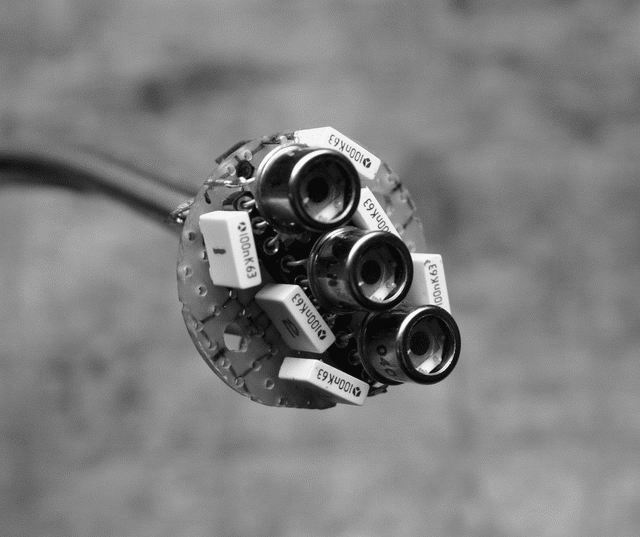
- A board with 3 UDT hybride diodes has been prepared and installed on SXR1 probe. After the connection of the probe on MST, we found that one UDT diode stopped to work. Tomorrow we'll check.
- In order to install the UDTs, the board has been rotated 90 degrees with respect to the position of the IRD array. To compensate this the probe has been rotated 90 degrees anticlockwise (looking at the diagnostic from behind, this is orientation=poloidal 90) and a rotated pinhole has been installed (same dimensions as the one used for the IRD diodes). This way the chords are stll in the poloidal plane.
- The SXR1 Be foil has not been replaced, and is stll 13 microns. The foil is flat, not curved, since the UDTs are mounted 90 degree.
- The distance from the pinhole to the diodes plane in 11.09 mm, very close to the distance between the pinhole and IRD array. UDT has larger active area, and the solid angle of the UDT chords are similar to those of the IRD diodes.
- The edge UDT chords have fixed gain 1.5x10^6 (1.5 Mohm) and the central one has 3.0x10^5 (300 kohm). The 2x and 5x of the iso amps will be used to increase the signals.
- All the other diodes are 1x10^7.
- UDT outputs are hooked up directly to the iso-amps. Channel of the SXR1 diodes 1,3 and 5 have been used.
- All moveable probes are extracted and the VAT valves are closed.
- All digitizers of the tomography are stll turned off.
13 Aug 2004
- SXR1 dismounted and the defective UDT diode repaired. Probe installed on MST and roughed; VAT closed.
- SXR3 encoder installed. Now all the probes have encoder.
- Pulsefile modified, now the new TR1612 digitizers have been installed on the MRAW_MISC.CAMAC.SXR_TOMO subtree. Tag names of the inputs are still \sxr_tomo_tr1612_t_dd, where t=1...5 is the module and dd=01...16 is the input. The other devices installed in the pulsefile on 7 Aug 2004 have been deleted. Since the new devices have used the new version of the TR1612 driver, now the data on the pulsefile are "true" raw data, and the factor 5.0/2.048 is not necessary. All this is valid from shot 1040813010, and since that shot the digitizers are on and enabled to receive, convert and store data.
- Started to work on the cables of the SXR1, which will be expanded from 12 to 20 diodes, the cables of the Hamamatsu 14 diodes array and the cables of the ELAD 10 miniaturised preamplifier prototype. These will be installed one of these days, before I leave (before the end of August).
14 Aug 2004
- Worked on the trigger of the tomography. With J.Sarff helping, the five trigger inputs of the TR1612 have been daisy chained, instead of using five different output of the Jorway. The single output of the Jorway, now it is output 9 of the CAMAC rack #1, must be enabled in the pulsefile, path MST.TIMING.TIMERS.CRATE_1.A1_TIMER:CHAN_09, and set to "gate" (using setup device of traverser). The value of this field has been set to \T_SXR_TOMO_TRIG, which is the tag of the field TOMO_TRIG in MRAW_MISC.CAMAC.SXR_TOMO. This filed is an array of two elements, [-5.0e3,-4.5e3], and specifies the gate for the encoder system. The Jorway output not used are set to \MST::BLANK. The new trigger works from shot 1040814006.
- The encoder system is using the output 4 of the Jorway, CAMAC rack #1, which is not correctly define, and this is the reason why the encoder is not working. A cable has been hooked up in the daisy chain of the TR1612 starting from shot 1040814110, and since then the encoder started to work. SXR1 and SXR2 seem fine, but diode 1 of SXR3 and diode 18 of SXR4 have no encoder voltage pulse.
- 200 kA standard and PPCD shot. PPCD from shot 1040814010. Shots 1040814119-121 are 400 kA PPCD.
- Gains are 1x10^7 for all diodes, except SXR1 which has UDT1,3 with 5x1.5x10^6 and UDT2 with 2x3x10^5. From shot 105 diodes 1,3,5 and 16,18,20 are 5x10^7. From shot 110 UDT2 is 5x3x10^5.
- SXR1 probe has been inserted @124 mm, poloidal 90 deg for orientation of the chords, from shot 1040814105. From that shot to the 400 kA PPCD discharges the UDT diodes have no SXR signals; also, it seems the UDTs are more noisy than the SXR diodes (see for example shot 115, between 5 and 30 ms, with the same X and Y scale on the scope). Maybe the gain is too low (but with 400 kA PPCD SXR2 signals are saturated, and the solid angles of the UDTs and the IRD diodes are very close), or there is something obstructing the UDT diodes.
- At the end of the session, the SXR1 has been dismounted form MST, and the UDT diodes have been checked. No problems found; without the Be filter but with the pinhole the UDTs are working (checked with a led @ 1 kHz), so no obstacles are present in front of the diodes.
- It seems that the Be1 and Be2 signals are 10 microseconds in advance with respect to the plasma current signal and the SXR tomography data (see for example shot 021 between -0.01 and 0.05 ms, plasma current, Be1, Be2 and the SXR2,3,4 data - look at the spike @ the beginning of the shot). The Be1 and Be2 are digitized @ 100kHz with a TR812.
- For all shots #1040807005 - #1040814005 the time base of the tomography diodes is not aligned, and a delay of 5ms can exist between diodes of different TR1612. This problem has been solved from shot #1040814006.
15 Aug 2004
- Possibly the quartz window in the UDT (about 0.650 mm thickness) is opaque to the soft x-ray. Tried to remove the window from a spare UDT, with success.
16 Aug 2004
- All the three UDT have no quartz window. Installed on SXR1 and tested, no problems found.
- The probe SXR1 was not light tightned, so the Be foil has been sandwiched between two pinhole foils. Light tightness ok.
- The gains of the three UDT have not been changed: UDT1,3=1.5x10^6, UDT2=3x10^5.
- Be foil is still 13 micron.
- SXR1 installed on MST, rough pumped. VAT closed.
- The SXR1 will be extended from 12 to 20 channels, so 8 new TLA and iso-amps will be build during this week. The box of the SXR1 TLA has been removed this morning, in order to replace it with a new one, bigger. The TLAs are still attached to the iso-amps, but the encoder system of SXR1 is not working.
17 Aug 2004
- Experimental session, 400kA, standard and PPCD plasmas; PPCD from shot 064 through 101. A good PPCD example is shot 071.
- SXR1, 3 and 4 inserted since the beginning; SXR1 is 124mm, SXR3 and 4 is 126mm.
- Output of TLA of diode 10, SXR2, has a BNC T with a 50ohm terminator, in order to divide by two the output signal. This is to increase the voltage range, to take into account the +/- 5V range of the TR1612 digitizers. During the whole session no problem found. Asked to Mikhail 30-40 BNC T and 50ohm terminator to divide by two all the outputs of the SXR1 and SXR2 probe; maybe not all the diodes, central chords should be enough. Perhaps some diodes of SXR3 and 4 will have the 50ohm, depending on the type of plasmas of the next weeks.
- SXR1 has three UDT diodes, gain are those of 16-Aug, iso-amps are x1, Be is 13 micron. UDT1 is looking towards the LFS, UDT2 has a central chord, UDT3 is looking towards HFS; this is the opposite with respect to the orientation of the chords with the IRD array (where diode 1 is pointing the HFS). In the pulsefile the ORIENTATION field is set to "poloidal 180" to take this into account.
- D1, SXR3 has no data for all shots. Later we realised the cable of this diode was disconnected from the BNC panel in the CAMAC rack #1.
- A few tests with the diode 2, SXR4, which has a non-constant baseline:
- shot 001-025, D1,SXR4 disconnected, D2,SXR4 on D1 cable and on D2 TLA. Baseline is not constant;
- shot 026-031, D1,SXR4 on cable D2 and on TLD D2, D2,SXR4 on cable D1 and on TLA D1 (the cable of D1 and D2 have been exchanged on the SXR4 flange). Now it is the output of TLA D1, which is measuring the diode 2 with a cable which was working, that has a non-constant baseline. When the D1 cable and TLA D1 is used on D1,SXR4 no problems are found. It seems like it is the diode 2 of SXR4 which is not working, or is not well grounded;
- Shot 032-101, D1,SXR4 on cable D1 and TLA D1, diode2,SXR4 on cable D2 and TLA D2, this is the original configuration. As before, D2,SXR4 has a non-constant baseline. THis diode should be checked, with a meter for example.
- The gains for the SXR2,3,4 diodes and the UDT have been changed several times during the day. The pulsefile contains the correct values, both for TLA and iso-amps.
- Encoder system:
- D1,3,20, SXR2 noisy (overshooting on the voltage pulse), D13,SXR2 maybe is not giving the right pulse;
- D4,18,SXR3 noisy (about 40kHz);
- D18,SXR4 is not working.
- Amplifiers:
- D20,SXR1, whose cable was not connected to the SXR1 flange, has a slowly oscillating baseline;
- D4,18,SXR3 do not change the transimpedance when the three-way switch is moved from 10^6 to 10^7, and the signals often saturates;
- D2,SXR4 with non-consant baseline; the diode of the array is maybe not working well.
- At the end of the session, @17:50, PP looses slightly the clamp which fixes the VAT valve to MST vessel, and breaks the vacuum. Pressure rised to 1.16 Torr. After one hour pressure was 10-5 Torr (turbopumps were opened to MST after 15 minutes from the accident). PDC started @18:45. Seems everything is going to recover quickly.
- SXR1 probe disconnected from MST; VAT valve closed.
18 Aug 2004
- D1,SXR3 cable reconnected to the BNC panel of the CAMAC rack #1.
- The BNC panel of the SXR1,2 diodes was not grounded to CAMAC, due to the paint on the panel which isolated all the BNCs. This panel (borrowed from J.Sarff) has been removed, and will be replaced with a new one, with enogh cables for the 20 diodes of SXR1 and the 14 channels of SXR2. This was the cause of the 1Mohm between the input and output BNCs of the iso-amps of SXR1 and 2. SXR3 and 4 have 15-30ohm, between input and output, with the iso-amps on, and 0ohm with the iso-amps off (remember that MST and CAMAC ground are connected through a copper sheet which goes from the MST vessel to the CAMAC rack #1). And maybe this was also the cause of the noisy signals of SXR2.
- Now it is clear why a cheater should be used for power supply of SXR4 TLAs and encoder system: the case is hooked up to the ground of the power cord, which goes to MST ground, and this case is also hooked up to MST ground through the output cables, which go to the TLA and the IRD diodes, grounded to MST on the teflon socket. The same is true for SXR4 power supply of TLAs and encoder system; in this case, since this case is mounted on the rack aside the CAMAC rack #1, a cheater is needed in order to prevent to short MST and CAMAC grounds (MST ground from the output cables and the TLA, CAMAC ground through the power cord). SXR1 and 2 TLA power supplies have not the case hooked up to the ground of the power cord, so no ground loops are present. In order to have the same layout for all probes, a cheater is used on all power cords of the four power supplies of the TLAs and encoder system.
- 40 BNC T and 40 50ohm terminations will be installed on the output of the SXR1 and 2 TLAs, in order to increase the voltage range (dividing by two the output signals). Maybe not all diodes of these two probes need to be terminated; and maybe also some diodes of the SXR3 and 4 might need the 50ohm, this is to be decided looking at the performance of MST in the next weeks-months.
- From shot 1040818009 the pusefile have the subtrees and nodes for the additional 8 TLAs and iso-amps (tags \MIK_67...74 and \ISO_67...74) and the field TERMINATION in each \MIK_** subtree with the resistor between the output of the TLA and ground (1e36 will be used to indicate no termination).
- Measured again the distance UDT - edge of the SXR1 probe. The average value is 10.88mm; UDT1 and 3 is 11.00mm, UDT2 is 10.65.
19-20 Aug 2004
- Worked on the electronics on the other days. In particular, corrected the ground-loop on MST: it was the ground cable of the SXR4 amps power supply. For this reason, in order to avoid these loops, a "cheater" is used on the plug of the SXR1,...,4 power supllies. 50ohm resistors have been installed on the output of the diode 5,...,16 TLAs of SXR2.
21 Aug 2004
- Shots with the 10 channels ELAD preamplifier installed in SXR1. Diodes 5,...,16 of SXR2 still with the 50ohm resistors. It seems that the diodes with the 50ohm saturate at 2.8V, instead of 5V.
- At the end of the day we realise that the SXR3 VAT valve is leaking, and this probe cannot be touched. The valve has been replaced on 1 Dec 2004.
22 Aug 2004
- 22 Aug 2004 - Worked on the SXR1 probe to install the 5mm offset pinhole.
23-24 Aug 2004
- Shots with the 4 probes. SXR1 with 5mm ofsset pinhole. Only diodes 9...20 of SXR1 available (iso-amps not all ready). The 50ohm on the TLA outputs of SXR2 are responsible of the "clipped" signals (in fact the output stage of the TLA is not powerful enough to drive the 50ohm resistor). From shot #1040823053 all the 50ohm resistors have been removed. A 50+50ohm divider has been installed on the iso-amp output of diode 10, SXR2.
- From 23 Aug the SXR1 probe has been inserted @ 129mm to take into account the 5mm offset of the pinhole (otherwise a few edge chords are obscured).
25-26 Aug 2004
- Worked on the electronics. 50+50ohm divider installed on the output of the iso-amps, directly inside the iso-amps box, for diode 1,...,12, SXR1 and 5,...,16, SXR2. All 20 diodes of SXR1 available. Actually, due to a mistake of the electronic workshop, diodes 1...8 and 17...20 of SXR1 have the dividers.
- Installed all patch cables for SXR probes. The following is the layout of the diode and inputs of the digitizers:
|
TR1612_1
slot13
|
diode
|
patch
cable
|
|
TR1612_2
slot14
|
diode
|
patch
cable
|
|
TR1612_3
slot15
|
diode
|
patch
cable
|
|
TR1612_4
slot16
|
diode
|
patch
cable
|
|
TR1612_5
slot16
|
diode
|
patch
cable
|
|
input 1
|
SXR1, 1
|
L1
|
input 1
|
17
|
Q1
|
input 1
|
18
|
U1
|
input 1
|
15
|
D3
|
input 1
|
11
|
H3
|
|
2
|
2
|
L2
|
2
|
18
|
Q2
|
2
|
20
|
U2
|
2
|
16
|
D4
|
2
|
12
|
H4
|
|
3
|
3
|
L3
|
3
|
19
|
Q3
|
3
|
SXR3, 1
|
A1
|
3
|
17
|
E1
|
3
|
13
|
J1
|
|
4
|
4
|
L4
|
4
|
20
|
Q4
|
4
|
2
|
A2
|
4
|
18
|
E2
|
4
|
14
|
J2
|
|
5
|
5
|
M1
|
5
|
SXR2, 1
|
R1
|
5
|
3
|
A3
|
5
|
19
|
E3
|
5
|
15
|
J3
|
|
6
|
6
|
M2
|
6
|
3
|
R2
|
6
|
4
|
A4
|
6
|
20
|
E4
|
6
|
16
|
J4
|
|
7
|
7
|
M3
|
7
|
5
|
R3
|
7
|
5
|
B1
|
7
|
SXR4, 1
|
F1
|
7
|
17
|
K1
|
|
8
|
8
|
M4
|
8
|
7
|
R4
|
8
|
6
|
B2
|
8
|
2
|
F2
|
8
|
18
|
K2
|
|
9
|
9
|
N1
|
9
|
8
|
S1
|
9
|
7
|
B3
|
9
|
3
|
F3
|
9
|
19
|
K3
|
|
10
|
10
|
N2
|
10
|
9
|
S2
|
10
|
8
|
B4
|
10
|
4
|
F4
|
10
|
20
|
K4
|
|
11
|
11
|
N3
|
11
|
10
|
S3
|
11
|
9
|
C1
|
11
|
5
|
G1
|
|
|
|
|
12
|
12
|
N4
|
12
|
11
|
S4
|
12
|
10
|
C2
|
12
|
6
|
G2
|
|
|
|
|
13
|
13
|
P1
|
13
|
12
|
T1
|
13
|
11
|
C3
|
13
|
7
|
G3
|
|
|
|
|
14
|
14
|
P2
|
14
|
13
|
T2
|
14
|
12
|
C4
|
14
|
8
|
G4
|
|
|
|
|
15
|
15
|
P3
|
15
|
14
|
T3
|
15
|
13
|
D1
|
15
|
9
|
H1
|
|
|
|
|
16
|
16
|
P4
|
16
|
16
|
T4
|
16
|
14
|
D2
|
16
|
10
|
H2
|
|
|
|
- All the digitizers have been installed in the same CAMAC rack of the previous modules (rack #1, slot 13...17). The trigger state comes from the output #9 of the Jorway 221. The TR1612 are daisy chained.
- Encoding system: from this day for several weeks there have been problems, and the encoders for some probes have been rebuilt a few times. The system started to work correctly for all channels in the middle of October 2004. But, from time to time, some channels did not work, for example diode 16...20 of SXR3.
27 Aug 2004
- End of the PF,FB visit. PP remains in Madison.
2,4 Sep 2004
- Shots with the SXR tomography. During these shots the 50+50ohm divider on the output of the iso-amp gives clipped signals just like the divider on the output of the TLAs.
- From 2 Sep the wrong dividers of SXR1 have been corrected, and now the dividers are on diodes 1...12 of SXR1.
- New vacuum regulations: before opening a valve one has to ask permission to all scientific coordinators of that week.
- From 2 Sep the VAT valves of SXR1,3,4 have been "cracked", and not fully closed, at the end of the experimental session.
7 Sep 2004
- Prototype of a new iso-amp ready, with divider before the output stage, to solve the clipping problem due to the divider on the output of the iso-amps. Tests on this prototype show no clipping problems.
9 Sep 2004
- Shots with the SXR tomography.
12 Sep 2004
- Shots with the SXR tomography.
17 Sep 2004
- Shots with the SXR tomography, 400kA PPCD.
- From these shots diodes 1...12, SXR1 and 5...16, SXR2 have the 50+50ohm divider inside the iso-amp, before the output stage.
18 Sep 2004
- Shots with the SXR tomography.
19 Sep 2004
- First DC and AC calibration of the SXR electronics.
22 Sep 2004
- From shot #1040922016 diodes 1...16 of SXR1 have -5...100 ms time base.
26 Sep 2004
- Shots with the SXR tomography, 400kA standard.
28 Sep 2004
- Shots with the SXR tomography.
29 Sep 2004
- From shot #1040929001 all diodes of the SXR tomography have -5...100 ms time base.
- During these shots (high current, up to 550kA, PPCD) the SXR signals saturates at 1x10^6 (minimum gain).
30 Sep 2004
- To solve the problem of the saturation of the SXR signals @ 550kA PPCD, we decided to replace the 10^8 transimpedance with 10^5, for all channels but diodes 18,19,20 of SXR1.
- The 10kHz filter on the TLA, which acted when the transimpedance was 10^8, has been removed. In fact the calibration shots of 19 Sep showed that there are modifications on the amp response due to the filter also for 10^6 and 7 transimpedance. This filter is now present only in the diode 18,19,20, SXR1 TLAs, for gain=1,2,5x10^8.
5 Oct 2004
- From shot #1041005078 all diodes of the SXR tomography have the new TLAs, with 10^5,6,7 transimpedance. Only diodes 18,19 and 20 of SXR1 have the old values, 10^6,7,8.
- The offset of the new TLAs has been tuned (zeroed) @ 10^5: this way the offset for the 10^6 and 7 is positive (and the SXR signals are negative since the output current of the detectors is negative). A positive offset increases the voltage range of the signals. The only point is that @ 5x10^6,7 the offset can be +3.5V, and the spikes etc on the signals can saturate.
10 Oct 2004
- Tuneup of 200 and 550kA shots.
- From this day the SXR3 and 4 probe have been inserted at 131mm, instead of the 126mm, used until 9-Oct (since August 2004). The 126mm was due to a mistake in the drawings. Probably the diodes 1 and 20 of SXR3,4 were obscured, and should not be considered.
- Correct inserting and zero positions are now:
| probe |
insertion (cm) |
zero (cm) |
| SXR1 |
129.0 |
87.0 |
| SXR2 |
37.1 (fixed probe) |
0.0 |
| SXR3 |
131.0 |
105.0 |
| SXR4 |
131.0 |
105.0 |
where "zero" is the position of the index in the sliding bar of the manipulators corresponding to the probe being aligned with the CF-KF adaptor, while "insertion" in the position of the index when the probe is in its measuring position (pinhole 1 cm from the inner wall of MST for SXR1 and SXR2, pinhole 2 cm form the inner wall for SXR3 and SXR4). See this picture for more details.
12 Oct 2004
- Tuneup of 200kA PPCD shots.
13 Oct 2004
- Tuneup of 200 and 550kA PPCD shots.
- From shot #1041013075 diode 10 of SXR2 does not work.
15 Oct 2004
- 200kA PPCD shots.
- The diodes 12 and 19 of SXR3 have broken iso-amps and the iso-amps rack has been removed. For this reason SXR3 signals are not present for all day.
- For these shots and for diodes 15,17,18, SXR1 and 1,3,18,20, SXR2 the offset has been tuned (zeroed) for transimpedance 10^6 (these channels had often saturations due to the positive offset, 3.5V).
16 Oct 2004
- Second AC and DC calibration of the SXR tomography electronics.
19 Oct 2004
- 550 kA PPCD shots.
- Diode 10 of SXR2 is working again.
- Diodes 12,17,18,19 and 20 of SXR3 are noisy. The iso-amps of these channels have been repaired on 15 Oct but the problem remains.
20 Oct 2004
23 Oct 2004
- End of PP visit.
- J.Sarff and J.Goetz have agreed to learn how to operate the SXR tomography. In particular J.Goetz will be the contact person for the operation of the diagnostic.
1 Dec 2004
- The VAT valve of the SXR probe (300T,-45P) has been replaced. The valve has been left in the "cracked open" position.
4 Feb 2005
- Shots with the SXR tomography.
16 Feb 2005
- Shots with the SXR tomography.
12,13 Mar 2005
- Shots with the SXR tomography, but J.Goetz set the gains 10 times smaller, due to wrong lables on the amplifiers.
1 Apr 2005
- Six 12.5 micron Beryllium foils have been purchased by MST. These foils will be used as replacement of the present foils and as spare parts.
2,3,10,11 May 2005
- Shots with the SXR tomography.
- Again (as on 12,13 March) the gains have been set incorrectly due to wrong lables on the TLAs (which still have the lables 6,7,8 for the old transimpedance). From shot #1050511041 the gains have been set correctly (400kA PPCD).
13 May 2005
- Diode 2 of SXR4 is probably broken: the impedance on the Lemo connector on the probe flange shows low on both directions, so that something is shorted in the probe (cable or diode). The diode 2,SXR4 cable has been left disconnected.
16,17 May 2005
- Shots with the SXR tomography (400kA without and with PPCD, resp.).
- Diodes 16...20 of SXR3 did not worked. After a check (power cord disconnected from TLA of diode 18, SXR3) the channels started to work again. After reconnection of the power cord also diode 18 started to work. These channels of the SXR3 probe often do not work correctly, and have to be checked from time to time.
top | back
|